San Jose, CA – Thursday night in the West Regional delivered two very different paths to the same stage, painting a portrait of March Madness in its purest form—where survival and supremacy can both punch tickets to greatness.
One came down to the final second, a heart-stopping sequence that will live in tournament lore.
The other was decided long before the final buzzer, a masterclass in offensive execution.
And together, they set up one of the most compelling Elite Eight matchups of the tournament—a collision of contrasting styles that promised to define what it means to win when everything is on the line.
Purdue survived.
Arizona dominated.
And the basketball world took notice.
The Art of Survival: Purdue’s Last-Second Heroics
Purdue’s 79-77 win over Texas was everything March is known for—physical, back-and-forth, and decided in a single, breathtaking moment. With less than a second remaining and the game knotted at 77, Braden Smith drove into the lane and put up a layup that caught iron. But Trey Kaufman-Renn, positioned perfectly under the basket like a hawk tracking its prey, tipped in the game-winner as time expired, sending the Boilermakers forward and ending Texas’ Cinderella run in the cruelest fashion imaginable.
The 6-foot-9 forward finished with 20 points, hitting his first seven shots and grabbing five rebounds in a first half that showcased his efficiency and basketball IQ. But it was that final tip—that split-second reaction—that will be replayed for years to come.
Texas guard Tramon Mark left everything on the SAP Center floor, pouring in 29 points on 11-of-15 shooting despite visibly limping on an injured left foot through the closing minutes. His performance marked the most points by a Texas player in an NCAA Tournament game since Kevin Durant’s 30-point outburst against USC in 2007. The 11th-seeded Longhorns, who had to win a First Four game just to reach the main bracket, pushed the second-seeded Boilermakers to the absolute brink.
It wasn’t a perfect performance from Purdue, but it didn’t need to be. Matt Painter’s squad stayed within reach, weathered every Texas punch, and executed when it mattered most. Fletcher Loyer added 18 points and Smith contributed 16 in a balanced attack that kept the Boilermakers afloat. Watch the full game highlights here.
They didn’t control the game.
They finished it.
And in March, that’s often the only thing that matters.
Offensive Symphony: Arizona’s Statement Performance
Arizona’s path looked entirely different—and perhaps more ominous for future opponents.
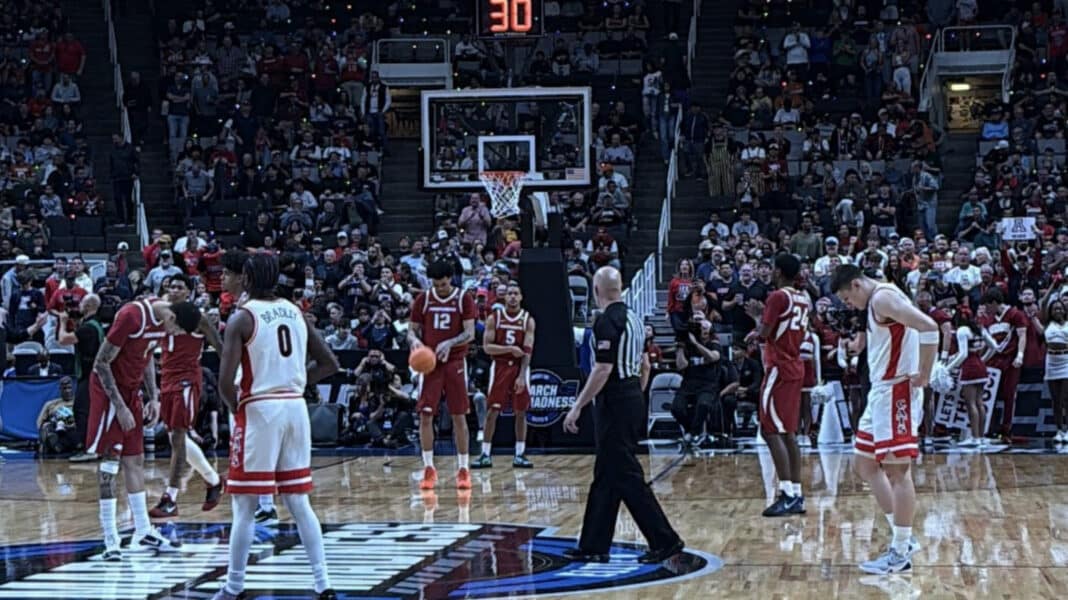
There was no late-game tension, no final possession drama, no uncertainty. Top-seeded Arizona overwhelmed fourth-seeded Arkansas 109-88 behind one of the most efficient offensive performances of the tournament, shooting a blistering 63.8% from the field—the best mark in a Sweet 16 game since 2005.
The Wildcats became the first team in NCAA Tournament history to have six players score at least 14 points in a single game. Freshmen Brayden Burries and Koa Peat each poured in 21 points, while Ivan Kharchenkov added 15, and Jaden Bradley, Motiejus Krivas, and Tobe Awaka each contributed 14.
“This is the most fun I’ve had playing basketball, honestly,” Peat said after the victory. “I love my teammates. Just seeing them be successful, it just makes me happy.”
The game never slowed down.
And neither did Arizona.
Tommy Lloyd’s Wildcats built a 54-43 halftime lead—tied for the fifth-most points scored in the first half of a Sweet 16 game—and never looked back. They shot 64% in the opening frame, made 15 of 17 free throws, and protected the basketball against Arkansas’ typically aggressive defense. The second half brought more of the same dominance, as Arizona pushed the lead to 18 and cruised to their first Elite Eight appearance since 2015. Relive Arizona’s dominant performance.
For Arkansas coach John Calipari, making his 17th Sweet 16 appearance, there were no answers. “They were on all cylinders, and we weren’t quite what we’ve been,” Calipari admitted. “That’s why you get a 20-point bulge.”
Despite Darius Acuff Jr.’s 28 points for the Razorbacks, Arizona’s balanced attack and relentless pace proved too much to overcome.
The Collision Course: Contrasting Identities Meet
What made Thursday night stand out wasn’t just the results, but how they were achieved—and what they revealed about the teams advancing.
Purdue relied on discipline, veteran poise, and late-game execution to survive one of the tightest finishes of the tournament. They’re comfortable in chaos, battle-tested in close games, and unafraid of the moment. When the margin for error disappears, the Boilermakers have proven they can find a way.
Arizona relied on pace, depth, and offensive rhythm to remove pressure altogether. They’re a team that doesn’t just beat you—they overwhelm you with options, suffocate you with efficiency, and make you question whether you belong on the same court. They haven’t been pushed, haven’t been tested in crunch time, and haven’t needed to be.
Two wins.
Two identities.
Two philosophies about how to win in March.
And that’s what made the Elite Eight matchup ahead so compelling—a team that had just survived one of the tightest finishes of the tournament against a team that had not been pushed at all. One comfortable in chaos, the other in control. One that knows how to win ugly, the other that makes winning look beautiful.
Thursday didn’t just decide who advanced.
It revealed how they would arrive—and set the stage for a fascinating clash of tournament DNA.
In March, that distinction matters. And on Saturday night in San Jose, we would discover which path leads further.